Trap Type Beats: A 2026 Buyer's Guide for Artists
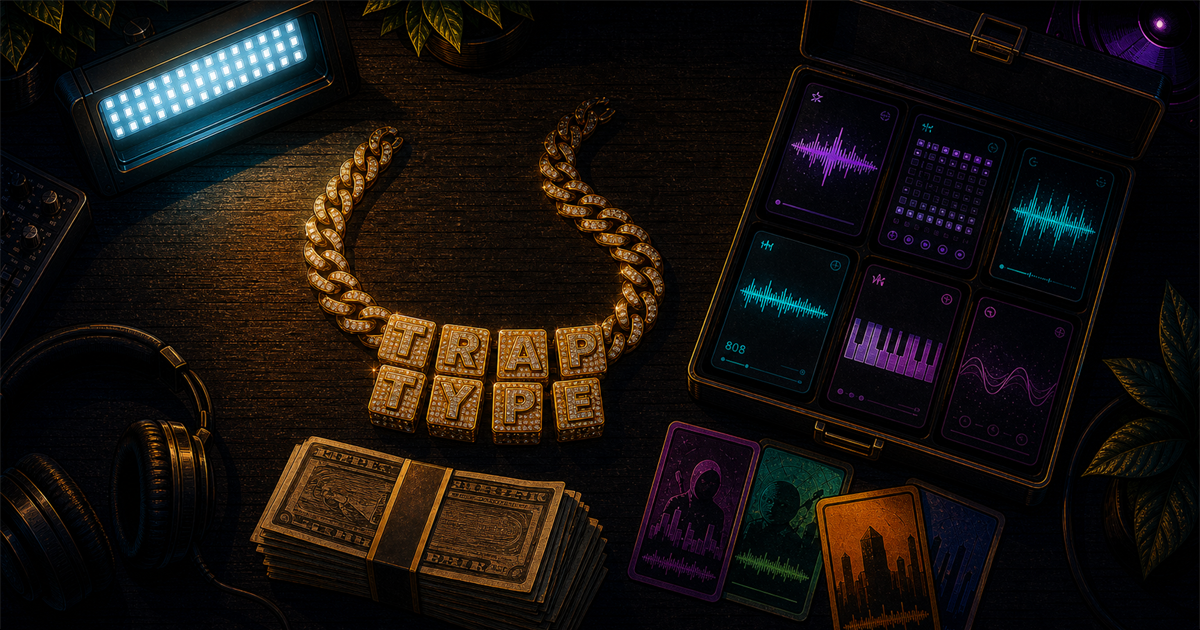
A trap type beat isn't just a hard 808 with fast hi-hats. It's a lane for vocal energy: dark pressure, melodic bounce, rage synths, plugg space, piano trap, R&B trap, or a drill-leaning hybrid.
That's why trap is one of the hardest beat categories to shop by name alone. In 2026, the useful question isn't "is this trap?" It's "does this 808, drum pocket, and melody make my voice sound natural?"
Quick Answer: What Makes a Trap Type Beat?
| Element | What you hear | Buyer check | |---|---|---| | 808 bass | Long notes, slides, distortion, or short bouncy hits | Does the bass lift your voice or cover it? | | Drum pocket | Half-time snare or clap, rolling hats, kick-808 movement | Can your flow sit without rushing? | | Tempo feel | Often 130-155 BPM, felt in half-time | Does it feel like space or pressure? | | Melody | Piano, bells, guitar, synths, pads, brass, or short loops | Does it suggest a hook without writing the whole song for you? | | Arrangement | Fast intro, clear hook lift, verse space | Can you enter within the first few bars? | | License and files | MP3, WAV, trackouts, stream limits, Content ID rules | Does the tier match the release plan? |
If you're new to type beat language, start with What Is a Type Beat?. The artist name in a title is only a search shortcut. The real purchase decision is tempo, pocket, key, structure, files, and rights.
Trap Lane Finder
Trap is broad, so choose the lane before you choose the beat.
| Trap lane | Core sound | Best artist fit | Watch-out | |---|---|---|---| | Dark trap | Minor keys, hard 808s, tense loops | Direct rappers, aggressive hooks, street energy | Can crowd low voices if the 808 is too long. | | Piano trap | Simple keys, steady bounce, emotional or luxury tone | Lil Baby-style pockets, motivational rap, melodic verses | Can feel generic if the piano loop has no hook lift. | | Melodic trap | Guitar, bells, soft synths, smoother 808s | Sing-rap hooks, pain rap, emotional verses | Needs a comfortable key for your hook. | | Rage / hypertrap | Distorted synths, bright digital energy, fast bounce | Character vocals, ad-libs, repetition, high energy | Can overpower delicate lyrics. | | Plugg / pluggnb | Airy chords, softer drums, lighter bounce | Relaxed flows, melodic pockets, internet rap | Too much space can expose weak tone. | | R&B trap | Softer chords, late-night mood, trap drums | Singers and rappers crossing into melody | Needs cleaner vocals and often a stronger WAV/trackout buy. | | Drill-trap hybrid | Trap bounce with sliding 808 or drill swing | Sharper cadences, colder hooks, street records | If the swing feels late, don't force a straight trap flow. |
The mistake is choosing the most exciting preview instead of the lane your voice can actually control. A huge rage beat may sound explosive alone, but a calm storyteller can disappear inside it. A minimal piano trap beat may sound plain alone, but become perfect once the vocal enters.
The 808 Fit Test
The 808 decides more trap purchases than the melody does. A beat can have the right mood and still be wrong if the bass masks your voice, fights your key, or fills every pocket you need for phrasing.
Before buying, do this quick test:
- Record the hook over the loudest section of the beat.
- Record four bars at normal energy, not your most dramatic performance voice.
- Play it quietly on phone speakers and ask whether the words still land.
If the main phrase disappears when the 808 hits, the beat may need trackouts, a key change, or a different low-end pattern. If your voice feels supported without forcing volume, you're closer. When I build a trap beat, I usually leave a gap in the low-mids for exactly this reason, because an 808 that sounds huge solo is the first thing to bury a vocal once the words come in.
| Your vocal style | 808 risk | Better beat choice | |---|---|---| | Low, chest-heavy voice | Bass masks the vocal body | Shorter 808s, less distortion, clearer midrange melody | | Fast triplet flow | Slides fight the rhythm | Cleaner 808 pattern with fewer pitch moves | | Melodic hook voice | Bass note clashes with sung notes | Beat with clear key and simpler root movement | | Whispery or laid-back delivery | Drum impact overpowers the vocal | Softer kick, wider melody, less clipped master | | High-energy ad-lib style | Beat feels empty between phrases | Rage, dark trap, or more active hat movement |
If the beat only works when the vocals are muted, keep browsing. Trap is supposed to hit hard, but the vocal still has to own the record.
BPM and Pocket: Don't Buy by Tempo Alone
Most trap beats live around 130-155 BPM, with many classic-feeling trap beats near 140 BPM. Artists often feel that as half-time, so a 140 BPM session can behave like a 70 BPM vocal pocket.
The lower side, around 120-135 BPM, often works for slower melodic trap, R&B trap, and heavier pockets. The middle, around 135-150 BPM, is the flexible trap zone for rap verses, piano trap, dark trap, and melodic street records. Faster trap, rage, and hypertrap can push toward 150-165 BPM or feel faster because the synths and hats create constant motion.
Tempo tells you where the grid is. Pocket tells you whether your voice belongs there. A rapper with precise timing may love a busy 150 BPM beat. A more conversational artist may sound better on a slower beat with fewer hat rolls.
Drums: Hats, Snares, and Space
Trap drums create movement without needing a live drummer feel. The snare or clap often lands on the 3 in standard 4/4, which gives the beat its half-time weight. The kick and 808 move together, while hi-hats add speed through 1/8 notes, 1/16 notes, triplet rolls, pitch changes, stutters, and pauses.
For artists, the practical question is space. Busy hats can make a beat feel expensive in preview but leave no room for dense lyrics. Sparse drums give you freedom, but they also demand more personality from the vocal.
Listen for the verse section, not only the hook. A trap beat that explodes in the hook but strips back in the verse gives you somewhere to rap. A beat that stays maxed out from intro to outro may require trackouts or a simpler vocal arrangement.
Melody and Mood
Trap melodies are usually short enough to loop, but strong enough to create a world. Pianos bring drama, bells bring coldness, guitars bring emotion, brass brings pressure, pads bring atmosphere, and synth leads bring rage or futuristic energy.
The best trap melody leaves an opening. If the loop already says too much, your hook may end up copying it instead of answering it. If the loop says too little, you have to create the whole song with delivery alone.
A simple test: hum your hook idea after the first 10 seconds. If the beat gives you a natural opening, keep it. If every melody idea you try feels like it's fighting the loop, the beat is probably not the right one for that song.
A Short Trap History Without the Costume
Trap came from Atlanta and the wider American South before it became a global production language. Early trap wasn't just an 808 pattern. It came from a specific street, regional, and lyrical context shaped by artists and producers such as T.I., Gucci Mane, Young Jeezy, Shawty Redd, DJ Toomp, Zaytoven, and later Lex Luger, Southside, Metro Boomin, Mike WiLL Made-It, TM88, Wheezy, and many others.
That history matters because trap isn't only a preset pack. The drums, low end, and dark melodic choices carry attitude. You don't need to imitate the artists in the title, but you do need to understand the energy the beat expects.
In the 2020s, trap spread into melodic rap, R&B, drill, rage, pop, Latin music, K-pop, and internet rap scenes. In 2026, it works less like one closed genre and more like a shared engine for different vocal styles.
How to Search for Better Trap Type Beats
Searching only "trap type beat" is too broad. Add the vocal problem you need solved.
| Weak search | Stronger search | |---|---| | trap type beat | dark trap beat with open verse | | Lil Baby type beat | piano trap beat for melodic rap pocket | | Future type beat | spacey trap beat with slow hook bounce | | Playboi Carti type beat | rage beat with ad-lib space | | Travis Scott type beat | atmospheric trap beat with hook lift | | trap beat 140 BPM | 140 BPM trap beat with clean 808 and WAV license |
The reference artist gets you close, but the second half of the search does the real work: dark, melodic, rage, piano, guitar, spacey, open verse, hook lift, clean 808, trackouts, or WAV.
What to Listen for in the First 30 Seconds
Don't let the first 808 hit make the whole decision. Listen like a buyer.
Does the intro give you a clean entrance? Does the hook section feel bigger than the verse? Does the 808 leave room for your main phrase? Do the hats make you rush? Can you imagine the first line without copying the artist reference in the title?
A strong trap beat usually reveals its promise early: tension, bounce, atmosphere, confidence, chaos, pain, or lift. If you can't name the promise after half a minute, the beat may be too generic for a focused single.
Choosing Dark Trap vs Melodic Trap vs Rage
Choose dark trap when the song needs pressure, threat, ambition, or direct rap energy. Your voice should sound strong without the beat doing all the acting.
Choose melodic trap when the hook carries the record. The key matters more, the chord emotion matters more, and the 808 should support the topline instead of swallowing it. For the dedicated lane, read Melodic Rap Type Beats: Finding the Right Vibe for Your Voice.
Choose rage or hypertrap when the vocal has character: ad-libs, short phrases, repetition, attitude, and energy. If the lyrics are detailed and intimate, make sure the arrangement has enough space or choose a softer trap lane.
Choose drill-trap when you want colder swing and sharper rhythm. If that's the direction, compare it with Drill Type Beats Explained: NY, UK, and Chicago Sounds before buying.
Files and Licensing for Trap Releases
Trap beats are often bought fast because the preview gives instant energy. Slow down for the license. Check commercial use, stream limits, music video rights, paid ads, Content ID, samples, publishing splits, and whether WAV or trackouts are included.
For a serious trap single, WAV is usually the practical minimum. Trackouts become valuable when the 808 is huge, the melody is crowded, or an engineer needs to carve space around the vocal. The file decision guide is MP3 vs WAV vs Trackouts: Which Beat Files Should You Buy?.
If you're still writing, a free or low-tier beat can be fine. If the song is going to Spotify, Apple Music, monetized YouTube, a music video, or paid promotion, read Free Beats vs Paid Beats: When Free Is Safe and When to Pay and Beat Licensing 101: Leases, Exclusives, and What Artists Need to Know before upload.
Common Mistakes Artists Make With Trap Beats
The most common one is choosing impact over pocket. The hardest beat isn't always the best song, and if your vocal has no space, the preview excitement won't survive the mix. Close behind is copying the artist in the title: a Future type beat shouldn't make you perform like Future, it should help you find a mood you can bend into your own language.
Ignoring key trips up a lot of artists too. Trap 808s are musical bass notes, so if the 808 root fights your hook, the song can feel wrong even when the drums are hard. Buying exclusive rights too early is the expensive mistake, because a WAV, trackout, or unlimited lease is often smarter until the song proves it has momentum. Use How Much Does a Beat Cost in 2026? if you're comparing tiers.
And watch for overwriting the verse. Busy trap beats often need shorter phrases, ad-libs, and pockets of silence, and filling every gap can make the record feel smaller.
A Practical Trap Beat Buying Workflow
Pick one lane first: dark trap, melodic trap, rage, plugg, R&B trap, or drill-trap. Then choose three beats in that lane and record the same rough hook over all three.
Listen the next day. The right beat usually makes your delivery sound more natural, not more forced. If one beat wins, check the key, files, license, and upgrade path before paying. If none win, change the lane, not only the producer.
When you're ready to compare options, use the catalog as a testing board: browse trap beats, pick two dark beats and two melodic beats, then record rough hooks before you buy.
FAQ
What BPM are trap beats?
Most trap beats sit around 130-155 BPM, with many classic-feeling trap beats near 140 BPM. Slower melodic trap can sit lower, while rage and hypertrap can feel faster.
What is the difference between trap and drill?
Trap is broader and usually centers on 808 bounce, half-time drums, hi-hat movement, and Southern rap influence. Drill is darker and more syncopated, often with sliding 808s and a stronger regional swing.
Should I choose dark trap or melodic trap?
Choose dark trap if the song needs pressure, aggression, or direct rap energy. Choose melodic trap if the hook carries the record and the beat needs to support singing, Auto-Tune, or emotional phrasing.
Do I need trackouts for a trap beat?
Not for every demo. For a serious release, trackouts help when the 808 is huge, the beat is busy, or an engineer needs to shape drums, bass, and melody around your vocal.
Can I release a song with a trap type beat on Spotify?
Yes, if the license gives you commercial distribution rights and the beat doesn't have unresolved sample or rights problems. Save the license, receipt, producer contact, and file delivery proof.
Who invented trap music?
No single person invented it. Trap grew from Atlanta and Southern rap scenes, with many artists and producers shaping the sound across different eras.
Found your sound?
Browse premium beats crafted for artists like you.
Tags
Related Posts
What Is a Type Beat? Meaning, Search Terms, and Buying Rules
What is a type beat? A practical guide for artists: how type beat names work, what they aren't, how to search smarter, and what to check before release.
Afrobeats Type Beats: A Groove-First Buying Guide
Afrobeats type beats explained for artists: Afropop, Amapiano, Afroswing, Afrofusion, Alte, BPM, percussion pocket, hook phrasing, files, and licensing before release.
Boom Bap Type Beats: A Lyric-First Buying Guide
Boom bap type beats explained for artists: dusty drums, sample feel, BPM, lyric pocket, drumless vs classic lanes, trackouts, and sample-clearance checks before release.