How Much Does a Beat Cost in 2026? Real Pricing Breakdown
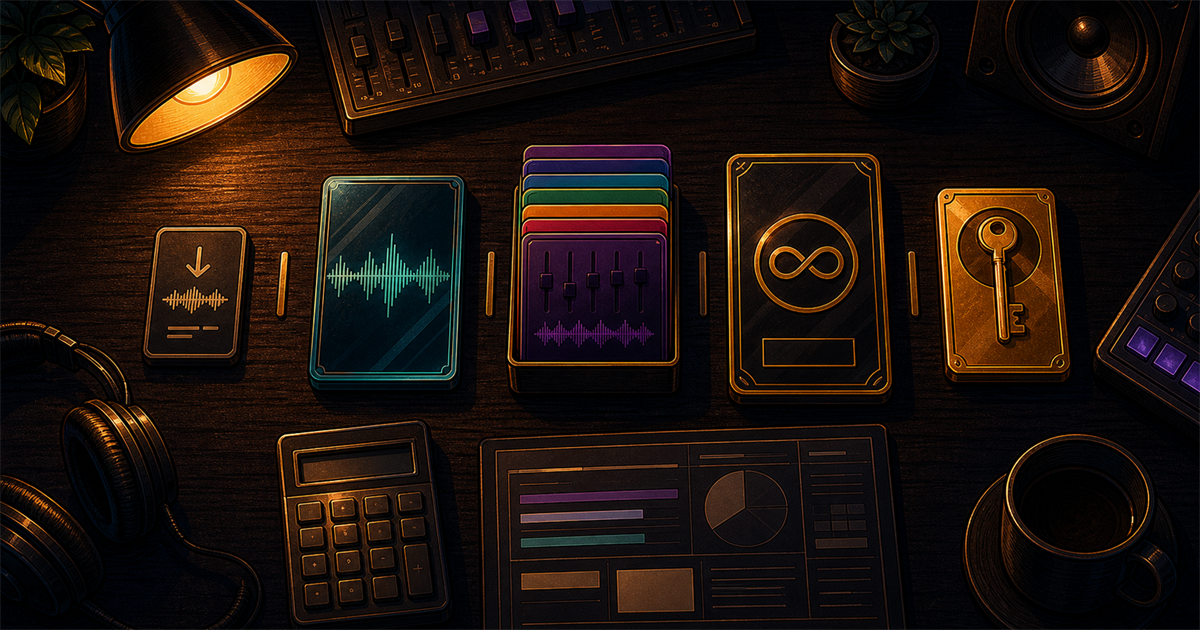
How much does a beat cost in 2026? For most independent artists, the realistic answer is: $25-$50 for a basic MP3 lease, $50-$100 for a WAV lease, $100-$250 for trackouts, $200-$500 for an unlimited lease, and $500-$5,000+ for exclusive rights. Custom beats can run from a few hundred dollars to $10,000 or more depending on the producer.
That range looks wide because "buying a beat" can mean five different things. A $30 lease and a $3,000 exclusive are not versions of the same purchase. They are different rights packages. Before you ask whether a beat is expensive, ask what you are actually getting.
Quick Answer: Typical Beat Prices in 2026
| License type | Typical price | What you usually get | Best for | |---|---:|---|---| | Free download | $0 | Tagged MP3, often non-profit only | Writing, demos, freestyles | | Basic MP3 lease | $25-$50 | MP3, limited streams/sales | Testing songs, early releases | | WAV lease | $50-$100 | Uncompressed WAV, higher limits | Serious streaming releases | | Trackout lease | $100-$250 | WAV plus individual files | Professional mixing | | Unlimited lease | $200-$500 | WAV/trackouts, no normal stream cap | Songs with growth potential | | Exclusive rights | $500-$5,000+ | Beat removed from future sale | Proven songs, brand-defining records | | Custom beat | $500-$10,000+ | Original commissioned production | Specific sound or campaign |
Public marketplace-wide medians are not always available, so treat the table as a working buyer range rather than a universal law. In my own Plutony Beats pricing ladder, the logic is similar: a $29 MP3 lease gets artists started, a $99 unlimited license with tracked-out stems covers serious releases, and full exclusive/custom licensing starts at $250 depending on the beat and rights needed.
What You Actually Get at Each Price Tier
A free beat is usually a writing tool. It helps you test flow, build demos, or post non-commercial content. It is not automatically cleared for Spotify, Apple Music, paid ads, sync, YouTube monetization, or merch campaigns.
A basic MP3 lease is the entry-level paid tier. It often gives you permission to release commercially, but with caps: streams, music videos, paid performances, radio, or sales may be limited. Because MP3 is compressed, it is not the best file for mixing or mastering.
A WAV lease is the practical minimum for a professional release. WAV files preserve more audio detail and give your mix/master engineer a cleaner source. If you are paying for recording, artwork, distribution, or promotion, saving $30 by choosing MP3 usually makes little sense.
A trackout lease includes individual beat files: drums, bass, melodies, samples, FX, and other separated elements. This lets the engineer carve space around your vocal instead of forcing your voice on top of a finished two-track. The guide MP3 vs WAV vs Trackouts: Which Beat Files Should You Buy? breaks down that decision. If you want the seller-side logic behind those tiers, read How to Price Your Music: Beats, Features, and Services.
An unlimited lease removes normal growth caps while staying non-exclusive. This is often the best value when you believe in a song but do not need to own the beat alone.
Exclusive rights stop future sales of that beat. They do not automatically erase older leases, and they do not always give you 100% publishing. Read the contract before assuming "exclusive" means "I own everything." For the legal side, start with Beat Licensing 101.
7 Factors That Change Beat Prices
Producer reputation and placements. A new producer may sell leases for $25-$50 and exclusives for a few hundred dollars. A producer with major placements can charge thousands because the price includes credibility, demand, and opportunity cost.
Genre and demand. Trend-heavy sounds can move faster. Drill, trap, R&B-trap, rage, and melodic rap pricing often shifts with demand. A niche boom bap beat may be cheaper, unless the producer has a strong audience in that lane.
License type. Non-exclusive leases stay cheaper because the producer can sell the same beat multiple times. Exclusive rights cost more because the producer gives up future sales.
File format. MP3 is cheapest. WAV costs more. Trackouts cost more again because they unlock professional mixing control.
Stream and sale limits. A 50,000-stream cap and an unlimited license are not equal. If your song starts moving, a cheap lease can become expensive later when you need to upgrade quickly.
Custom vs catalog. Catalog beats are already made and can be sold at scale. Custom beats require time, revision, communication, and often a higher fee.
Marketplace vs direct. Marketplaces add convenience, templates, payment systems, and automated delivery. Direct deals can be flexible, but only if the producer gives you a real contract and clean files.
Red Flags: Overpriced or Suspiciously Cheap
A beat is suspiciously cheap when the seller claims exclusive rights for $20, refuses to show a license, or only accepts irreversible peer-to-peer payment. A real exclusive usually requires a written agreement, clear ownership terms, and removal from future sale.
A beat may be overpriced when the producer charges exclusive-level money for a basic lease, refuses trackouts, cannot explain publishing splits, or hides major restrictions until after payment. Price alone is not the problem. Unclear rights are the problem.
Watch for these signs: no license preview before payment, no producer name or history, no clear file format list, no stream/sale limits stated, no Content ID rule, no refund or delivery policy, and pressure to buy immediately through DMs.
How to Budget for Beats as an Independent Artist
Do not spend your whole release budget on the instrumental. A strong song also needs recording, mixing, mastering, artwork, distribution, short-form content, and promotion. If your total budget is $300, spending $250 on an exclusive leaves no room to finish the record properly.
A practical beginner budget looks like this: buy a $50-$100 WAV lease, record clean vocals at home or in a small studio, pay for a solid mix/master if needed, and save money for visuals and promotion. Upgrade to trackouts if the song is strong enough to deserve a professional mix. Consider unlimited or exclusive rights only after the song proves momentum.
For artists with $500-$1,000, the strongest move is usually not one expensive exclusive. It is two or three carefully chosen WAV/trackout leases, better recording quality, and a real release plan. I have seen $20-$30 lease buyers turn into long-term exclusive or custom clients, so I do not treat a lower-tier first purchase as unserious. I treat it as the start of a relationship.
When to Pay More
Pay more when the song is already working. If a demo gets strong feedback, the hook is undeniable, and the beat is central to the record, trackouts or unlimited rights can be worth it. If the song is growing toward a stream cap, upgrade before the producer sees the momentum and raises the exclusive price.
Pay more when you need control. Sync, ads, brand campaigns, label pitches, and serious music videos often require stronger rights than a basic lease.
Pay less when you are still testing. A $30-$50 lease is fine for a first single, a SoundCloud drop, or a song that helps you learn your sound. Just do not pretend it is the same as an unlimited license.
The honest answer is this: a beat should cost enough to give you the rights and files your release needs, but not so much that the rest of the song suffers. Browse current Plutony Beats instrumentals, compare license tiers, and choose the price point that matches your actual plan: see beats and license options.
FAQ
How much does an exclusive beat cost?
Most independent exclusives land somewhere between $500 and $5,000+, but smaller producers may start lower and established producers can charge far more. The real question is what the exclusive contract includes: future sale removal, publishing terms, trackouts, Content ID rights, and previous lease language.
Why do some beats cost $20 and others cost $5,000?
A $20-$50 beat is usually a non-exclusive lease. The producer can sell it again. A $5,000 beat is usually exclusive, custom, or tied to a producer with placements and demand. You are paying for rights, files, control, and opportunity cost.
Are expensive beats actually better?
Not always. Expensive beats can come from proven producers, but price does not guarantee fit. A $50 WAV lease that fits your voice can beat a $2,000 exclusive that makes you sound forced.
How much should a beginner artist spend on a beat?
For a first serious release, a WAV lease in the $50-$100 range is often enough. Spend the rest on recording quality, mixing, cover art, and promotion. Upgrade to trackouts or unlimited rights when the song proves it deserves more.
Can I negotiate the price of a beat?
Sometimes, especially for exclusives or custom work. Be specific, respectful, and clear about your release plan. Do not negotiate by insulting the beat or the producer; ask what license tier fits your budget.
Found your sound?
Browse premium beats crafted for artists like you.
Tags
Related Posts
How to Buy Beats Online Safely: Avoiding Scams in 2026
Buying beats online in 2026: a 9-point safety checklist, how to verify a producer, and what a real exclusive license must include.
Free Beats vs Paid Beats: The Real Difference (And When Free Costs You)
Are free beats really free? When you can use them safely, when they will cost you, and how a smart hybrid strategy keeps your releases clean.
MP3 vs WAV vs Trackouts: Which Beat Files Should You Buy?
MP3, WAV, or trackouts — which beat files should you actually buy? A simple decision guide based on what you'll release and who will mix it.