Producer's Block: How I Deal With Creative Slumps
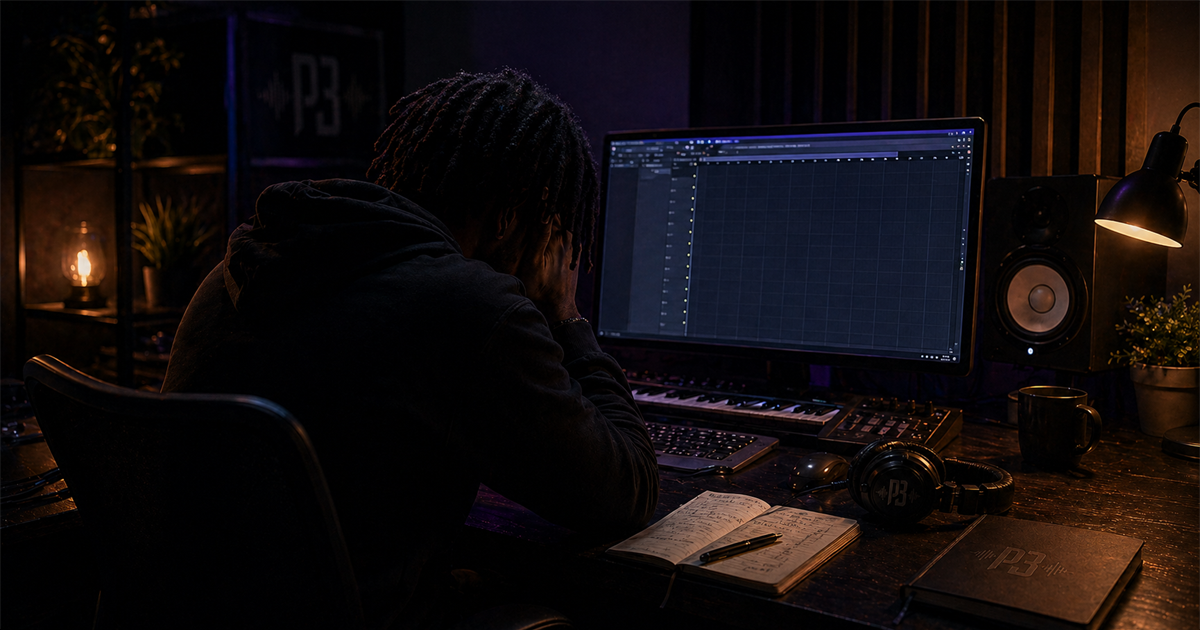
Producer's block does not always arrive like a dramatic crisis. Sometimes it looks like opening the same session three nights in a row, replaying the same loop, and slowly convincing yourself you forgot how to make music.
I have been there more times than I can count. The way out is not usually a new plugin or a heroic twelve-hour session — it is learning how to diagnose the block, lower the pressure, and get moving again.
Recognizing the Signs of Burnout
There's a specific feeling I've come to recognize after years of making beats. You open your DAW, stare at the empty arrangement, and loop the same eight bars for forty minutes while absolutely nothing clicks. It isn't laziness. It isn't distraction. It's producer's block, and if you've been at this long enough, you know exactly what I'm talking about.
For me, the first warning sign is boredom with my own sounds. I'll pull up a sample pack I've used a hundred times and nothing moves me.
The second sign is the loop trap — playing back what little I have instead of building on it, fishing for a spark that just isn't there. If I've been in the loop trap for more than twenty minutes, I know it's time to step away and actually diagnose the problem rather than force my way through it.
Burnout in music production sneaks up on you because it doesn't feel like exhaustion. It feels like a sudden loss of talent. But after making over 800 beats under the Plutony Beats name, I can tell you: it's almost never a talent issue. It's almost always one of three things — mental fatigue, creative monotony, or disconnection from the music that originally inspired you. Naming which one it is changes everything about how you respond to it.
Techniques That Get Me Back in the Zone
The fastest fix I've found is what I call the one sound, ten minutes rule. I pick a single instrument — a piano, a guitar loop, one synth patch — and give myself exactly ten minutes to build something around just that element.
No drums for the first five minutes. No layering. Just that one sound and a melody. It strips away the paralysis of infinite choice, which is usually the real culprit killing my sessions rather than any shortage of ideas.
Another approach that consistently works for me is constraint-based producing. I'll limit myself to a single drum kit, or lock myself into a narrow BPM range, or impose a rule like "this beat has to resolve in four bars."
Constraints sound restrictive, but they do something counterintuitive — they swap the pressure to be creative for the pressure to solve a specific puzzle. Puzzles are far easier to start than open-ended art, and once you're moving, momentum tends to carry you forward.
When I'm genuinely stuck, I go back to reference listening. I'll put on a playlist of beats I genuinely love — not to copy them, but to reconnect with the feeling I'm chasing. Sometimes I'll have one of those tracks playing softly while I jam in my DAW without recording anything at all. The goal is to recalibrate my ear and remind myself why I started making music. Usually within twenty minutes, something starts pulling at me and I'm ready to actually build.
I also keep a folder I call throwaway sessions. These are sessions I open with zero expectations baked in — sandbox beats where nothing has to be good.
Knowing that a session carries no weight completely changes the creative energy inside it. Some of the beats I'm most proud of started life as throwaway sessions I almost didn't open.
Sampling as Inspiration
Sampling has rescued my sessions more times than I can count, and I don't mean that in the traditional chop-and-flip sense, though that works too. I mean treating the world around me as raw material.
I'll record ambient sounds — rain on a window, street noise, a fan spinning, even a conversation drifting through a wall — and run them through a pitch shifter, sampler, granular tool, or wavetable resynthesis workflow. What comes out is almost always unrecognizable and entirely my own. It breaks the mental loop because the starting point is something completely unfamiliar, which bypasses whatever creative block has been running on repeat in my head.
Studying the production techniques inside records I love also rewires my thinking in useful ways. I'll pull up a J. Dilla or a Madlib track and try to reverse-engineer a single element — just the hi-hat pattern, or the way the bass moves against the kick, or the reverb tail on the snare. This is analytical listening, not imitation, and it consistently surfaces ideas I never would have reached by staring at a blank session. The beat I make afterward rarely sounds like what I studied, but it carries an energy I borrowed without stealing.
Changing Your Environment and Routine
Producer's block is often a signal that your brain needs different inputs, not more of the same. For a long time I thought the answer to a bad session was another session — push through, grind harder. That approach almost never worked and usually left me feeling worse than when I started.
Now I treat a genuine slump as an instruction to change context entirely. A walk with headphones, listening to music I wouldn't typically make, consistently shifts my perspective faster than anything else. Getting off the screen and doing something physical — cooking, moving furniture, taking a different route somewhere — lets the subconscious do its processing work without interference from a screen full of empty tracks.
I've also experimented with changing when I produce. For years I was a late-night producer exclusively. When I started trying early morning sessions, sometimes before I'd even looked at my phone, I found a noticeably different quality of focus. The creative mind seems less defended early in the day, before the noise accumulates. If your usual schedule feels stale, shifting the clock can feel like working in a different studio entirely.
If you produce at home, try setting up in a different spot even if it's just a kitchen table. Novelty stimulates the brain in ways that feel disproportionate to the actual change. Some of my favorite Plutony Beats sessions have happened away from my main desk with nothing but a laptop and a pair of headphones, simply because the change of scenery reset my relationship with the music.
Why Bad Beats Are Part of the Process
The hardest thing I had to accept early on is that bad beats aren't failures. They're calibration data.
Every poor session teaches you something about where your ear is currently at, which sounds you've grown tired of, and what territory you need to explore next. That's not wasted time. That's training data you can't get any other way.
I have beats in my catalog that I thought were genuinely bad when I made them. Months later I'd come back, swap the drums, adjust the bass by a few semitones, and suddenly have something I was proud to put out. Fresh ears change everything. What sounds wrong in the moment is sometimes only wrong for that particular moment, for that particular headspace.
The trap I see most producers fall into is treating a creative slump as evidence of a ceiling — as if they've reached the limit of what they're capable of. That feeling is almost always wrong.
What's actually happening is that you're caught between levels: your taste has outpaced your current output. The music you're making hasn't caught up yet to the music you can hear in your head. That gap is uncomfortable, but it's also exactly where growth lives. Every producer you admire has sat at a blank screen and felt precisely what you're feeling right now.
The only way out of a slump is through it. Through it doesn't mean forcing bad sessions until something accidentally works. It means staying genuinely connected to music — listening deeply, exploring widely, making peace with the messy middle part of the process. I wrote more about that long-game mindset in the 800-beats story.
Before you close this tab, try one small reset: open a throwaway session, set a ten-minute timer, use one sound only, and save the idea even if it is bad. Producers need real tactics more than motivational quotes, and that one small session is enough to start moving again.
Found your sound?
Browse premium beats crafted for artists like you.
Tags
Related Posts
How I Made 800+ Beats: Lessons from Years of Producing
I didn't get my first placement until beat #450. Here's what those years taught me about consistency, workflow, and surviving the grind.
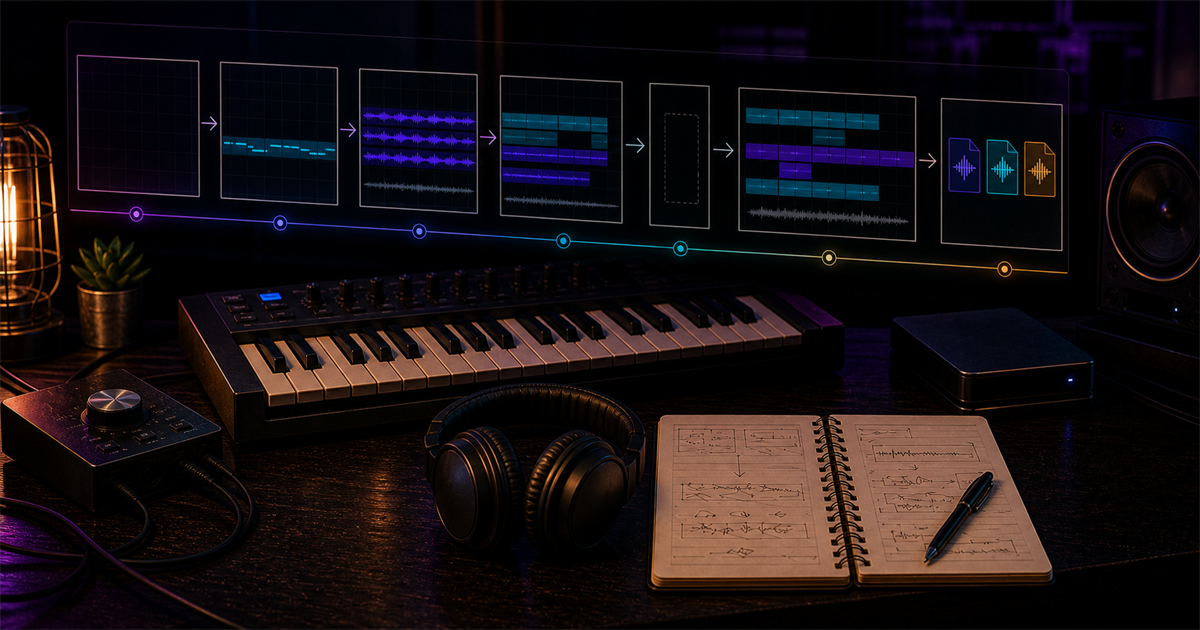
My Beat-Making Workflow: From Blank Canvas to Finished Beat
My complete beat-making workflow from blank canvas to finished beat ready for sale — melody, arrangement, mixing for vocals, and export tips.
The Tools I Use: My Current DAW, Plugins, and Setup
FL Studio, Omnisphere, Serum 2, and a minimal desk setup — here's every tool I actually use to make beats in 2026.