How to Write Rap Lyrics Over a Beat: Step-by-Step Guide
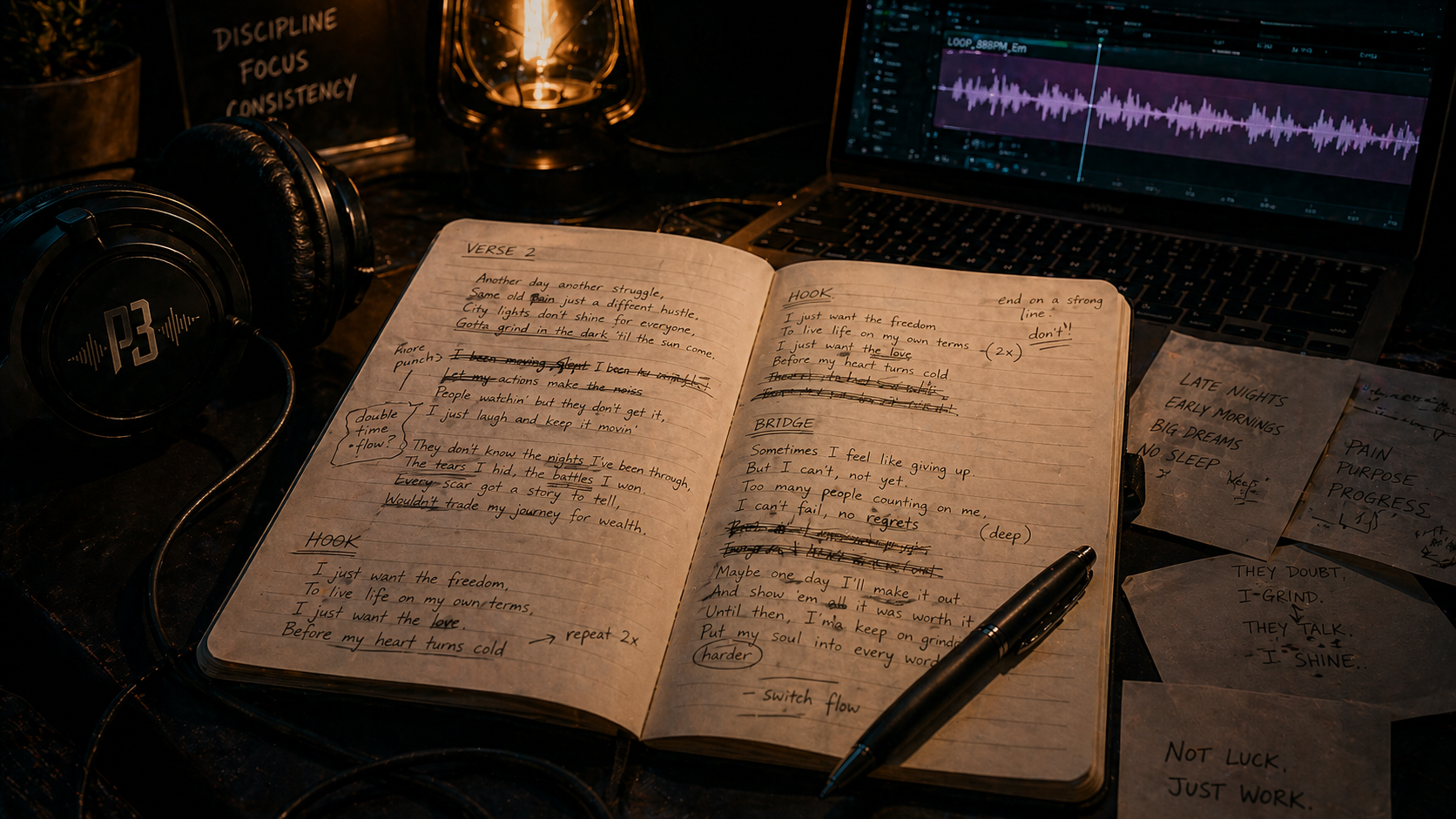
Writing rap lyrics over a beat can feel overwhelming when you're staring at a blank page with an instrumental playing on loop. The trick is to stop thinking of the beat as background music and start treating it as your creative partner. Every kick, snare, and hi-hat is telling you something about how your words should land. Whether you're writing your first verse or your fiftieth, this rap songwriting guide breaks the process into concrete steps so you can go from blank page to finished song.
Finding the Pocket: Understanding Beat Structure
Before you write a single word, spend time just listening. Play the beat at least ten times without trying to rap over it. Pay attention to where the kick drum hits — that's usually where your strongest syllables should land. The snare typically falls on beats 2 and 4, and that's your anchor point.
Most beats follow a predictable pattern: an intro (usually 4-8 bars), then the verse section opens up. You'll notice the energy shift when the verse starts — maybe a new melody comes in, or the drums get fuller. That's your cue. Your lyrics need to match that energy arc.
Think of the pocket as the rhythmic sweet spot where your voice locks in with the drums. When you're in the pocket, your words feel effortless. When you're out of it, everything sounds forced. The best way to find it is to hum or mumble nonsense syllables over the beat before writing actual words. Let the rhythm dictate the cadence first, then fill in the meaning. This mumble-first approach is how most modern rappers write lyrics over a beat — they find the melody and rhythm before the words.
Counting Bars and Riding the Flow
A bar in rap is one musical measure — typically four beats. Most rap verses are 16 bars long, though modern trap songs often use 12 or even 8. Count along with the beat: "1, 2, 3, 4" is one bar. Do this until counting becomes automatic.
Your flow is the rhythmic pattern of your syllables over those bars. Start simple. Take a line like "I'm walking down the street and I see the lights" — that's a straightforward flow where each syllable sits evenly on the beat. Now try syncopation: push some syllables slightly ahead of or behind the beat. That tension between your voice and the drums is what makes a flow interesting.
A practical exercise: tap your hand on the desk in time with the snare. Now try rapping your lyrics so that your rhymes land exactly on that tap. If they don't, adjust the syllable count. You might need to add a word, cut one, or swap for a synonym with a different rhythm. Rappers like Kendrick Lamar are masters at this — listen to how his syllables land precisely on the drums in tracks like "DNA."
Don't be afraid to switch flows mid-verse either. A lot of modern rap uses a different cadence for the first eight bars than the last eight. That contrast creates momentum and keeps the listener locked in.
Writing Your First Verse: Hook, Verse Blocks, and Rhyme Schemes
Start with the hook, not the verse. The hook is the most memorable part of the song, and it gives your verse something to build toward. Keep it short — two to four bars — and make it catchy. It should communicate the core emotion or message of the song.
For your verse, begin with a strong opening line. This is the first thing people hear, so it needs to grab attention. Avoid starting with filler like "yeah, uh, you know what it is." Instead, drop the listener straight into a scene, a statement, or a question.
Build your verse in four-bar blocks. Each block should develop one idea. Think of it like paragraphs in an essay: Block 1 sets the scene, Block 2 deepens it, Block 3 adds tension or a twist, Block 4 drives toward the hook. This structure keeps your writing focused and prevents rambling.
Rhyme schemes are your glue. Here's how the main ones look in practice:
AABB (couplets — each pair rhymes): I started from the bottom, now I'm chasing dreams (A) Nothing ever handed, had to build my team (A) Late nights in the studio, running out of time (B) But every single struggle turned into a rhyme (B)
ABAB (alternating — lines 1 and 3 rhyme, 2 and 4 rhyme): I started from the bottom, now I'm chasing dreams (A) Late nights in the studio, running out of time (B) Nothing ever handed, had to build my team (A) But every single struggle turned into a rhyme (B)
Once you're comfortable with end rhymes, experiment with internal rhymes — placing rhyming words in the middle of lines. Multisyllabic rhymes ("dedicated / educated," "running the city / nothing is pretty") sound more advanced and create a tighter weave. Don't force rhymes that don't make sense just because they sound good — meaning always comes first.
Matching Your Energy to the Beat's Mood
A dark, minor-key trap beat at 140 BPM demands a different approach than a laid-back boom-bap instrumental at 90 BPM. Before writing, identify the beat's mood. Is it aggressive? Melancholic? Uplifting? Your lyrics should amplify that emotion, not fight against it.
Tempo affects your word density. Faster beats (130+ BPM) often work better with shorter phrases and more space between them — think Travis Scott or Playboi Carti. Slower beats (80-100 BPM) give you room for dense, storytelling bars — think J. Cole or Nas.
The musical key matters just as much as BPM. Beats in minor keys like Dm, Am, and Em lean darker and more introspective — they are natural fits for storytelling, pain, or aggression. Major keys like C, G, and F feel brighter and work well for uplifting or party tracks.
When you are shopping for beats, this info saves time. Knowing what key a beat is in also helps if you plan to add melodies — you will know which notes to sing instead of guessing after the verse is already written.
Vocal tone matters too. You don't need to be monotone on a sad beat, but screaming an aggressive delivery over a soft R&B instrumental will clash. Record a quick 30-second test take to check if your voice sits well with the beat before committing to a full verse. Try two or three different energies — whispered, conversational, aggressive — and see which one locks in.
Common Mistakes Beginners Make
The biggest mistake is writing lyrics without a beat playing. Lyrics written in silence almost never fit naturally over an instrumental. Always write with the beat on, even if you're just scribbling in a notebook — have it playing through headphones. Your brain automatically adjusts syllable count and rhythm when it hears the drums, so let it do that work for you.
Another common trap is prioritizing complex rhyme schemes over clarity. If your listener can't understand what you're saying on the first listen, your rhymes don't matter. Practice enunciation and make sure your message comes through. Record yourself and listen back — you'll catch mumbled words and awkward phrasing that you missed while writing.
Don't try to sound like your favorite rapper. Your voice and cadence are unique, and forcing someone else's style will always sound like a bad impression. Instead, study what makes their flow work — the rhythmic patterns, the rhyme placements — and adapt those techniques to your own voice.
Timing your writing sessions helps too. Set a timer for 30-45 minutes per verse and force yourself to finish within that window. Without a deadline, you'll second-guess every line and never complete anything. The first draft doesn't need to be perfect — it needs to exist. You can revise later, but you can't edit a blank page.
Finally, don't overwrite. Your first draft is just raw material. Cut the weak lines, tighten the syllable counts, and replace generic words with specific ones. "I got money" says nothing. "I turned rent money into a studio session" tells a story. Specificity is what separates forgettable bars from memorable ones.
How to write rap lyrics is ultimately a question answered by doing it. Pick a beat, set that timer, and write. Don't judge the quality — just finish the verse. Do this every day for a month, and you'll be shocked at how much your writing tightens up. The beat is your partner, not your enemy. Learn to listen to it, and the words will follow.
Your next step is simple: open the Plutony Beats catalog, choose one instrumental with a clear BPM, key, and mood, set a 45-minute timer, and write one hook plus one 16-bar verse. If you are still unsure which instrumental fits your idea, use the companion guide, How to Choose the Right Beat for Your Song, then come back and write to the beat that gives you the strongest first hook. That is the whole rap songwriting guide in action: listen first, write second, revise third.
Found your sound?
Browse premium beats crafted for artists like you.
Tags
Related Posts
Autotune for Beginners: When and How to Use It
Learn how autotune works, how to dial in the right settings for rap vocals, and when using it will actually hurt your sound.
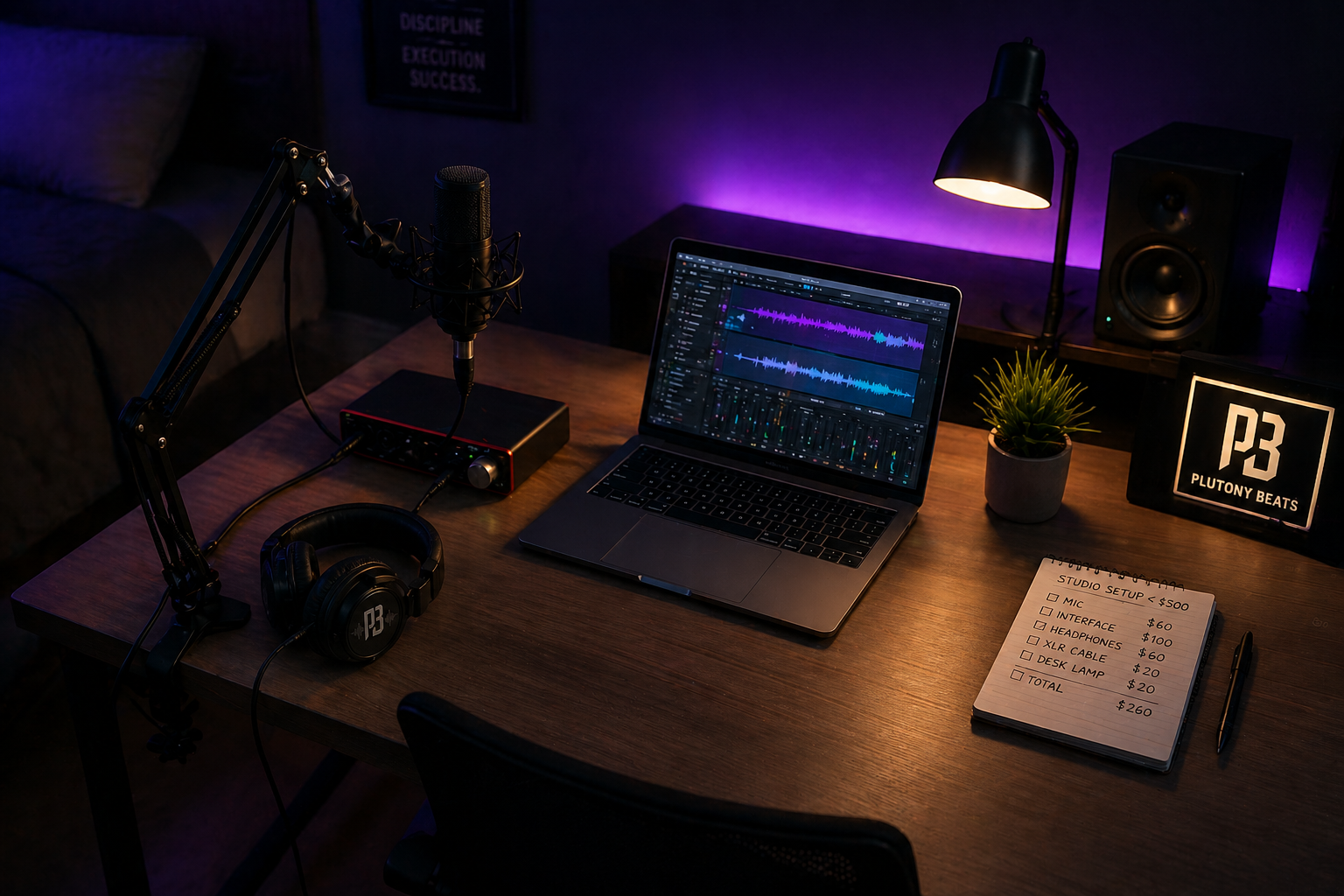
Building Your Home Studio Under $500
Home studio setup cheap: the exact gear, DAW, and acoustic treatment you need to record professional vocals for under $500.
How to Choose the Right Beat for Your Song
How to choose a beat for your song: BPM matching, key and mood analysis, genre fit, and the test-recording method that saves money.